For several years now
I’ve been searching for a floor standing fully adjustable slate frame and
although these are readily available the modern version is nowhere near as good
as those of the 19th century. So imagine my delight when in the
local depot vente I discovered a fine fruitwood example in perfect working
order for only 40 euros. They had no idea what the contraption was or just how
useful it would be to me. The one big advantage with a floor stand support is
that both hands are free to work which theoretically speeds up the process of
embroidery. In addition this 120 year old example had split hinged rails with
gripping pins that allowed for quick assembly as well as rolling on if required
for longer pieces. I’m in the process of making a William Morris influenced
embroidered bag for a fine carved wooden hinged support that has been
kicking about for ages on my to do list. The old curtain material dates from the early
part of the 20th century and I remember them from my childhood days
when mother was either taking them up or letting them down depending on what
height the windows of our latest house were. I felt only a slight guilt when
cutting a section off but I needed no more curtains and this fine fabric could
also do well for upholstery or cushion backing. Nothing will be wasted, not if
I can help it although as I folded the remainder back into the chest I did
wonder just how long it would be before they saw the light of day again.
Monday, January 28, 2019
PAINTING OVER GOD
The first and only painting my father bought from me was a
rather uncomfortable looking female nude study. I never understood just what
attracted him to that image beyond the fact that his son had painted it. It
soon became a point of embarrassment between us and like most mistakes ended up
in the downstairs toilet. Some years later and following a reasonably successful
still life exhibition I suggested that I paint over the nude and with a look of
relief he agreed. I made no special preparation other than turning the image
upside-down and painted this second oil directly over the first. The resulting
freely painted gourds and brass rimmed wooden bowl was a great improvement and
I enjoyed the fact that I could still make out the partial ghost image of the
first painting.
So enjoyable was the experience that I repeated the process of
painting over another nude study with a Breton scene of a girl collecting water
form a well. Here again the traces of the nude model seated contra jour before
a large window still remained ghostly visible to my eye at least within the
granite gable wall of the farmhouse but to the purchaser all appeared fine.
When reusing canvases in this way I enjoy the process of painting through the
confusion that often results in capturing a second image and the incidental
nature of that under paint can at times provide interesting texture.
Only once have I had an inquiry to buy a painting that had
already disappeared beneath a second or even third layer so on the whole this
method of working has provided more sales than it has lost.
There are occasions when a partial repaint is required to
correct a composition and this worked particularly well when transporting my
father’s prize winning pig from inside the sty to outside in the field with a
view of the old barn at Quarry farm near Poulton in Gloucestershire.
While the
entire background was repainted the Wessex saddleback pig remained untouched. A
similar process was required when recently I converted a large canvas of cattle
within a Breton landscape into a South Uist view where only four out of the
seven cows were retained.
Almost a quarter of a century ago shortly after the old
presbytery in Plouye had been emptied I discovered in a local bracante the
front panel of the altar covering from the chapel of St Salomon which depicted
a rather naïve rendition of God, resplendent with red cape, triple tiered trinity
crown and clutching an orb between three raptor like fingers. During the
subsequent restoration of the chapel it was not deemed necessary to incorporate
this panel and so it has remained forgotten in my attic. So the other day while
preparing a couple of old door panels for painting I felt it also was time to paint
over God, replacing him with something suitably naïve but perhaps a little more
sophisticated in its execution. While I wanted the subject matter to be more
decorative I also needed it to be less ecclesiastical and so I settled on an
architectural façade.
A few years ago a friend lent me a rather distressing
photographic book on demolished building of Scotland throughout the 20th
century. I selected the burnt out ruined remains of the mid-18th
century Ward House in Aberdeenshire as the perfect subject matter for the panel
repaint. I wanted a complete house portrait that would fit the landscape aspect
of the panel but also to include some period people to add interest and scale.
While some primitive folk art painting can be very simple and effective this
would require a more pain staking detailed approach. I find myself slipping
back more than half a century to my early days at Tregony School in Cornwall and a time
when my drawing and painting remained unsophisticated, still retained a certain
level of naivety.
Thursday, January 10, 2019
TULIPS
Tulips
1 Schoon Solffer 2 Lawrence’s Polyphemus 3 Rose Bacchus
4 Strong’s King
5 Beste Bruyne 6 Tulipa lutea lituris aureis 7 T.
orphanidea 8 Speramondi
9Semper Augustus 10 Nazende al 11 Furuzende 12 Agate
Maurine.
The wild
tulips are native to the Mediterranean regions, Asia Minor and the Caucasus and
extend as far east as China. The finest of these species are found around
Bokhara and in Turkestan. It is generally considered to have been introduced
here from Turkey during the mid-16th century. The German collector
Graeber who worked for the Dutch nursery firm of van Tubergen wrote in the
Botanical Magazine of Tulia lanata in the Asiatic Soviet Russia, “Every ravine
in the red sandstone slopes reveals new forms which break the monotony of the
leathery leaved pistachio and almond scrub. From the first days of spring there
sprout here anemones, crocuses, irises, tulips, fritillaries and long shafted
eremuruses.”
It puts me
in mind of springtime in Tolsta, the crofts carpeted in orchids and on the
machair and dunes the scent of primroses.
Having purchased an illustrated
volume on tulips from the Bathesda charity shop for 50p I was inspired to paint
a few specimens that illustrate the diversity the family tulipa encompass.
While flowers attract insect life to aid in the method of reproduction so they
also lift our spirits. We enjoy both giving and receiving flowers and the
youngest of children without bidding would pick a bunch of wild flowers for
mother. I remember a friend telling me she was so overwhelmed with the carpets
of daffodils on the outskirts of Bath that she didn’t think at all before
stopping and picking a bunch. She was brought back to reality with a jolt when
a passer-by hurled some verbal abuse her way and threatened to call the police.
Today’s bouquet of exotic blooms can be purchased throughout the year at any
filling station or supermarket, carefully chosen foliage texture setting off
the vibrant flowers full of sadly odourless colour. There are flowers for every
occasion with Lily of the valley still being given to customers on May 1st.
Weddings demand flowers but one has to specify no flowers at a funeral if you
don’t want a repetition of the Lady Di syndrome. In France chrysanthemums are
reserved for the dead and while arum lilies associated with funerals in England
it is common to see them in a French bride’s corsage. Roses are inexplicably
linked to love and war while the blood red of poppies are reserved for
remembrance. The extra ordinary value put on tulips in the 16th
century meant they were seen as a symbol of wealth that in the inevitable crash
was once again observed in the late 20th century equivalent of
bursting of the dot com bubble.
Birds of a feather
This time last year I was enjoying the warmth of Western
Australia and the hospitality of friends, recovering from the usual round of
seasonal party gatherings and looking forward to a walk about adventure in the
National Parks of Cape Le Grand and Fitzgerald. This also proved to be a
lucrative time as far as collecting feathers in the form of road kill. I hasten
to add that I was borrowing the old Discovery Land Rover solely for transport
and not as a method of destroying feathered wildlife. Given the speed of
vehicles these days it is hardly surprising that casualties on the roads are
inevitable but when I find myself at the side of the highway recovering some
innocent victim to pluck I do take time to thank them for allowing me to take
some of their feathers for my artwork.
Exporting feathers from Australia is not
a problem but getting them back in most definitely is. When in the spring of
2013 I held an exhibition of these feather bird pictures in Perth WA I brought
them in unframed and decided to take the risk of not declaring them to customs.
They were well wrapped into a sealed sketch pad and I breathed a sigh of relief
when the nice Golden Labrador sniffed my back pack and moved on. That time all
the work had been completed in Brittany but this time I decided to complete the
botanical water colour part while in Australia. Now back in Brittany I am busy
with the gluing of feathers and trying to keep warm in the studio during the
rather non-physical process. As with all of my art I try to push myself to the
limits of my capability, which in the case of this exacting work leads to ever
more complexity and precision. The birds are entirely of my own Hickmanii
imagination and bare only passing resemblance to any living species. When
mounted and framed they will feature as another wall of exhibits in the “All
that I do” exhibition at An Lanntair, Stornoway Arts Centre this coming
September.
By reusing natures detritus to form works of art there is also a
true sense of recycling and while in no way can this be regarded as up-cycling
in shape or form they do possess more decorative charm than their dearly
departed. The finished framed pictures will be for sale from £250 to £400
each.
Tuesday, December 18, 2018
A new herd of folk art sheep coming onto the market in 2019.
It was during the winter of 2014/15 when out in Western
Australia that I stitched the first small flock of sheep on tweed. Between the
soaking windswept crofts of Lewis and the parched stubble outback of south west
Australia there would seem to be no possible connection and yet sheep manage to
thrive in these most extremes of climate. In the extreme heat of the day and in
what seem like impossibly dry conditions sheep gather beneath a lonesome gum
tree with heads bowed close to the ground, while out on the Hebrides the
Scottish black face sit tight up against whatever shelter they can find as the
prevailing north westerly storms bring lashing rain. The oldest recorded sheep
in the world was in Australia and at 23 years of age it died of heat stroke. On
the Isle of Lewis in the village of New Tolsta John A Maciver discovered one of
his sheep bore an ear tag which indicated it was 24 years old. The ewe had gone
missing out on the moors for several years and had become wild and very weary
of humans. She was accepted back into the fold still with a good set of teeth
but during handling lost one of her rather fragile horns. During a violent
winters storm while grazing near the cliff edge she was blown into the sea
which seemed as fitting an end as heat stroke was in Australia.
I started stitching on the long haul flight to WA and
completed a small flock during my three month stay and the reaction from
friends was so positive that I was encouraged to frame them up for sale.
During
an exhibition in 2017 in the Victoria Gallery in Bath the small flock of twelve
all sold and since then these folk art textile images have continued to sell.
As with all forms of artwork each unique rendition continues to evolve with
additions of flowers, crofts houses, light houses, ships and even wind
turbines. The images have also become more complex with more than one sheep or
a lamb and ewe and with the additional work comes an increase in price. Down
south in galleries they were retailing framed at £265 while from my studio I can
sell them without commission for £185.
Next year’s flock of sheep on tweed are taking shape. It is
rare for me to follow a line of creative production for long but in the case of
the sheep on tweed they have proven amusing as well as saleable.
Being stitched
entirely by hand means each sheep is unique and while I give little thought to
the complexity of any particular image I am now compelled to start pricing them
on an individual basis which takes account of the hours entailed in their
production. Up to now they have been set at a uniform £185 each but next year I
expect there will be some around £250 plus. Time is always a sensitive point
when dealing with labour intensive work and while I consider myself to be a
more than competent embroiderer I am not prepared to debase that work simply to
produce a more affordable object or to accept less than the minimum hourly
rate. Each images is crafted to the best of my ability and many contain an
element of experimentation and discovery which give them their folk art charm.
The sheep in this latest series are contained within a landscape that evokes
island life whether that be simply the proximity to the sea with boats and
light houses, the traditional shielings and habitation, or the more recent
visual impact of the wind turbines. Thanks to the very generous donations of
tweed off-cuts by local weavers the backgrounds have become an equally important
part of the finished product. Over the next couple of months I will turn to
making the frames and hope by lambing time to have a further 20 for sale.WISE WORDS
There are times when having read some consider wise word
from the past that they strike home and clarify my own present day visions. Such
was the case when Simon handed me the short volume “Living Traditions of
Scotland” by his father George Scott-Moncrieff a slim booklet published by His
Majesty’s stationary office in 1951.
The booklet encompasses all
Scottish traditional crafts throughout the ages from the perspective of
architecture which was George’s life-long preoccupation. When considering
ornamentation he states that simple “functional” objects can be more pleasing
for their line and shape than the over ornate. I was reminded of some equally
wise words of advice having planted a rambling rose on the front of my studio
here in Brittany: A good architectural façade requires no embellishment, use
the climber to hide the hideous. George goes on to state that due value is
given to an object through the proper use of material and their associated
qualities, be it stone or wood or metal, wool or straw or linen. Concerning the
traditional Highland “black house” while acknowledging that modern improvements
are possible, it is always foolish to assume that any old tradition was pursued
merely because our forefathers did not know any better. The ruined remnants of
such houses will still be standing long after today’s kit home constructions
have blown from their concrete foundation slab.
“In Scotland, as elsewhere, what
is remarkable is the quality of design and workmanship shown in very early times,
as through man’s innate sense of, and desire for, beauty could inspire him to
remarkable heights even against a comparatively slight background from which to
draw; a tradition established, maintained, and developed right up to the
limitations of its materials and techniques.” We would do well to reflect on
that the next time our gaze falls on a selection on key rings or fridge magnets
in the local tourist shop. “It is difficult fully to account for the general
deterioration of design during the nineteenth century. Certainly much of the
blame must lie with the development of the machine, with its divorce between
the designer and his materials, and its too great emphasis upon facility of
production and cheapness of cost”. He emphasises that machine goods need not be
ugly but warns against the tendency to be over-concerned with production and
profit to the detriment of design and functional beauty. In looking at the fine
things that men and women have made and that they still strive to make we may
feel that they stand for the control of mind and hand, for a generosity of
labour, for a search for perfection within the bounds imposed by the immediate
object. When the work is done with intimate care then the craftsperson
impresses their own spirit upon it. “By sympathetic use of the tools in their
hands they can interpret their life and build and maintain their tradition”. So
the computer generated image stitched onto tweed by an installed program has no
soul and without that important human element also has no intrinsic value. Our
highly skilled crafts people are being asked to debase their ability in order
to produce work that is cheap enough to market for the masses, which in turn
only increases the amount of produce that ends up in the rubbish bin. It is bad
enough sitting through a slideshow of friends latest holiday without having to
say thank you for some ghastly bauble from the Bahamas. I gave up buying gifts
many years ago and instead treat myself to something special approximately
every five years and this will have absolutely nothing to do with key rings of
fridge magnets.
The second half of this 1951 booklet is concerned with advertising where
Reid and Taylor Ltd of Langholm Dumfriesshire boast of being makers of the
world’s most expensive Twist Cheviot Cloths suitable for town and country. Nicoll
Brothers of Bankfoot, Perth makers of sporrans since 1834 emphasise wholesale
enquiries only, while Bailey’s Edinburgh branch offer Chateau Moulion Rose
Medoc at 8/6 per bottle or a Chateau Mouton-Rothschild at 10/6.
Saturday, November 24, 2018
IN SEARCH OF SLEEPING BEAUTY.
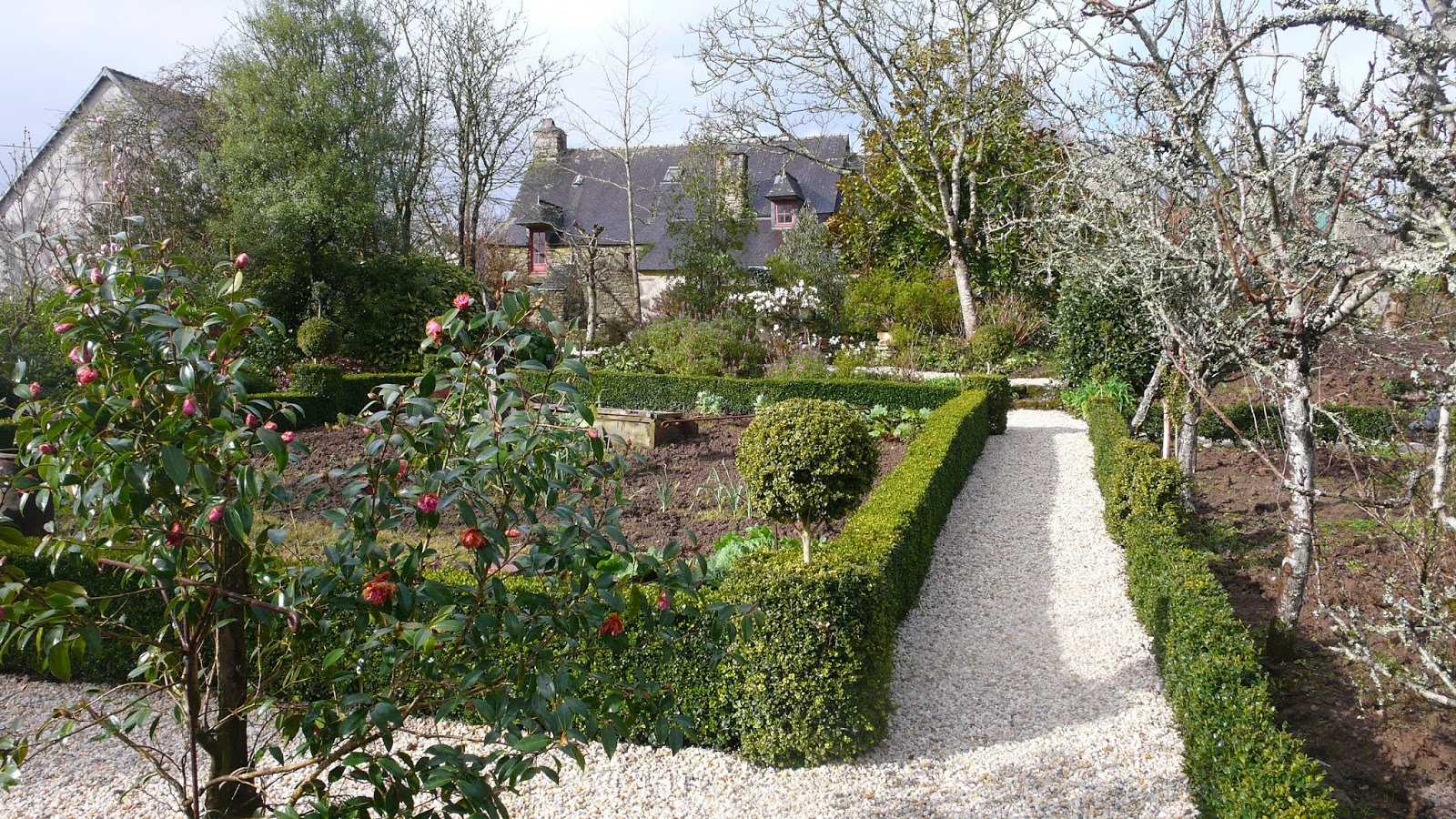
On arriving back at my old farm house in Central Finistere I
wondered if during the drive south and the many stop offs to see friends along
the way I had not somehow slipped into a deep slumber for several years. For
how could such an explosion of growth within my once tidy garden be explained?
I was sure I’d left it back in the spring clipped, pruned and weeded, with
gravel paths raked and fruit garden dug over. I could just about make out the path
but now a healthy mix of shrubs and brambles hindered my progress as I elbowed
my way down to the washing line and the shed at the far end. I had assumed the
summer drought would have slowed things but here in valley of the Ellez the
rain during May followed by exceptional heat had produced prolific growth. In
the furthest corner under the peach tree I noted the sad rotting evidence of
what must have been a bumper harvest and wondered having told my immediate
neighbours before I left to pick them why they hadn’t. It took a couple of
hours to hack back the tangled mass of wisteria that had managed to climb the
gable wall shrouding both the bedroom window and the external electric meter.
Around the far side of the kitchen the evergreen climbing hydrangea had made it
up onto the roof as well as spreading across the back door and bathroom window,
while the hydrangea petiolaris had managed even greater heights reaching the
chimney on the north gable. These I would have to tackle with a ladder over the
following week but the main body of the garden was going to be a much longer
project. I always assumed that shrubs would mean relatively low maintenance but
without the simplicity of the bitter easterly sea breeze of the Outer Hebrides
to perform its annual trimming the work here was going to be considerable. Six
months growth in Brittany would equate to six year growth in Tolsta but in
relaxing on the manicured garden front at least the hedgehogs have flourished.
During my journey south from Lewis I had slept in three
different beds, two nights on a settee and the back of the van plus a further two
on Sam’s narrow boat. Now it was time to light the fire, crawl into the old box
bed, close the sliding door on the world outside and enjoy the familiarity of
its firm comfort. That first night back in Brittany brought high winds and rain
which revealed two leaks in the roof. One I could hardly miss as it trickled
onto the slate work surface alongside the cooker and the other I heard dripping
a steady rhythm on the bedroom floor. I chose to ignore both placing a bowl
under each until the morning. I dreamed
of a world where the remnants of man’s ancient endeavours were barely
discernable beneath aerial roots and dense verdant growth, a world where below
in the dark depths sleeping beauty still slumbered and life was only possible
in the uppermost moss cover branches of towering trees.
After a week of hacking back undergrowth and the
accompanying bay scented bonfires the house had lost its fairy-tale abandoned
look, and I had decided to rip out both fig trees and the wisteria. The sober
granite façade of this Breton farmhouse requires no floral embellishment.
Finding a balance between artwork and the physical efforts of gardening is not
always easy as the fine weather meant I should do as much as I could while the
sun shined. Often by mid-afternoon I’d had enough, so stuffing apples in my
pockets I would head off for a walk up the valley to call in on friends and
return with a bag of blewit mushrooms and sweet chestnuts.
There are now nine houses in and around the hamlet of Lezele
occupied by English people and none of them speak to me for fear I might turn
out to be French. All so very different to that adventurous spirit of thirty
years ago when the few intrepid English people who ventured across the channel
made an effort to learn the language. We were seen as a novelty and the Bretons
were fascinated to have a foreigner in the village. Back then many villages
were deserted with the roof timbers of houses and sheds protruding from rampant
ivy. Today as I walk through those same villages although restored and re-inhabited
they seem quieter than ever, devoid of life as adults and children alike remain
indoors glued firmly to their tablets no doubt. The Pied Piper of progress has
removed more than just the rats.
Subscribe to:
Posts (Atom)