Friday, May 13, 2022

A TRIUMPH OF TULIPS


Two year ago I planted some tulip bulbs to brighten up the rough patch of grass that grows where the original entrance used to be. The ground is gritty and hardly merits the term soil, which at least means that the meagre grass hardly ever needs cutting. Just as well as I’ve never own a lawn mower. This spring there has been a good showing to the point that I’m almost embarrassed by the vivid violence of such brash primary red that would seem more at home in an urban or town setting. Those petals with the luscious texture of the finest satin have no place in a landscape of heather and heath, and yet that very out of place positioning renders them the more remarkable. They have taken their time in coming into bloom and are unlikely to last long with the lashing of wind and rain we are promised this week, so I sat a while on the bench out front and enjoyed. 

The tulip in native to Central Asia and Caucuses with 14diffwerent species growing wild in Turkey. From the 16th century onward the tulip became an integral part of Ottoman culture as can be seen across all forms of the decorative arts. The obsession with tulips spanned the reign of Sultan Ahmed III (1703-30) and became known as the tulip era. In Turkey and later in Holland laws were enacted to control speculation. In England and the west tulips with round petals were preferred while the Turks only rated the dagger shaped petals. Tulips appear in Dutch still life oil paintings throughout the 17th century with masterpieces by Ambosius Bosschaert and Hans Bollongier and the standardised tree form of tulip made popular by illustrations in books such as Crispyn de Passe’s Horttus Floidus, and was used well into the 19th century. 


Forty years ago a pair of such painting turned up in a house sale down in Cornwall. From the estimated price I thought I might stand a chance of buying them. I was prepared to go up to £10,000 pounds but never even raised my hands as they eventually sold for £21,000. I’ve often found that not being able to buy or more importantly afford something has inspired me to make it myself. In my own homage to the tulips I used a style reminiscent of those 17th century Dutch botanical painters.              


Monday, May 2, 2022

UN BON GROS DODO


I wasn’t totally sure if the young man on the checkout in Tesco’s had been trained to ask me what I had planned for the rest of my day, or if he was genuinely interested to know. Since he had enquired so politely I felt I could at least inform him of what I would be doing on my return home.

“I’ll be stitching a Dodo”, I said.

He looked puzzled, so I added “You did ask”. As I loaded my purchases into my bag I endeavoured to expand a little on what was entailed in my particular complex form of embroidery, but it only seem to add to his confusion. I smiled politely behind my face mask and mumbled my thanks before heading off to the bus station and home. I had started the embroidery the previous day and was keen now to see how my idea for stitching feathers rather than fur would turn out.


 I had found an old engraving of a dodo in the 1889 edition of Chambers illustrated encyclopaedias and had done more research on line to arrive at a satisfactory image. I read early description of this comical and most cumbersome of birds in Oliver Goldsmith’s History of the earth and animated nature as being the most unwieldy and inactive of all nature. Everything about the dodo seem to contradict all the attributes that man had assigned to bird life.  Its body is massive, almost round, and covered in grey feathers. It is only just supported on two short thick legs, like pillars, while its head and neck rise from it in a manner truly grotesque.  Native of Mauritius, the French called it the nauseous bird, not only because of its appearance but its bad taste of flesh. Perhaps they simply hadn’t discovered the correct way to cook it for succeeding visitors reported its flesh to be good and wholesome eating. It was said that three or four dodos were enough to dine a hundred men. It is thought that it became extinct around 1680. There were however some interesting observations made before this took place. One was that it was not possible to domesticate them as during captivity they shed tears and eventually died. The nest of the dodo was made from a heap of palm leaves and only a single egg was laid. Each bird took it in turns to sit during an incubation period of seven weeks as well as protecting the chick when born. Any other dodo coming within 200 yards was chased away. The males would only chase away other males and female would only chase females.  In the gizzard of all birds a stone was found the size of a hen’s egg and it was concluded that they were born with this stone as even young birds had it. They also discovered that these stones made extremely good knife sharpeners and were used in preference to any other.


The images I found were many, ranging from the cartoon character cuddly toys to all possible forms of exaggeration. Using a compilation of the most realistic images along with various descriptions dating from the late 17th century I produced a drawing, which although remaining comical also does bare some resemblance to an actual dodo. Having transferred this onto white cotton fabric I began stitching, firstly with the tail, then moving on to the separate wing and drumstick leg, which would be attached to the main bird and padded out before then cutting out the entire embroidered bird. To create a feathered appearance I used a rough fishbone stitch that I would normally use for leaves. It seemed to work well, particularly when completed and padded out on the linen support canvas. The rough background drawing was then transfer to the canvas, and although this is never the definitive image it does serve as a guide for the embroidery that will constitute several tens of thousands of stiches. 


When tackling this sort of work I like to concentrate on a small area and finish it, rather than, say concentrating on one colour as one might when stitching a cross stitch kit. The image remained relatively fluid and would also have some raised areas, which were again stitched separately on an embroidery hoop. I wanted to keep most of the background as flat as possible to emphasize the rotundness of the dodo, but would allow some raised work in the foreground. As usual I start stitching at the top with the sky and trees. The sky was mostly in long-stitch, while the clouds and tree foliage were all in half French knots in order to keep the detail small enough to convey depth. This knot is very similar to a full French knot but goes only once around the needle before completion to produce a much smaller knotted stitch. I restricted the trees to three distinct but unknown species, which would leave me with plenty of opportunity to incorporate different varieties of green wools when it came to the foreground. It is a question of contrasting tones as well as colours which eventually gives depth. By the time I reached the half way stage I had passed from sky through the distant hills and forest to the middle foreground. In order again to give depth I introduced some water behind the bird, much as I had done with the Ocelot, separating it from the forested area. Once complete the needlework was stretched and box framed before setting it within the old gilt frame. I had right from the start decided to frame the dodo using one of my old recuperated gilt picture frames. Although in a somewhat decrepit state it was of good depth and a similar size to the French gilt framed needlework it would replace that hung above the headboard of the half tester bed. Any French toddler would immediately understand why I intended to hang a stumpwork embroidery of a dodo above the head of the sleeper. In French dodo translates as dodo, but also beddy-byes, un bon gros dodo- a nice long sleep.


Saturday, April 23, 2022

A HOST OF GOLDEN DAFFODILS


Spring has been threatening for several weeks now, and for me it’s always the bugling bulbs that herald the lifting of spirits. That and the arrival of the cuckoo this Thursday. As regular as the German black forest clock that carries its name, the cuckoo arrives all the way from Africa. Our Scottish cuckoos are not the same as those from England. They are better fed and migrate via Italy, not Spain. The distance flown by birds was in days gone by hard to imagine, when Whooper Swans headed north to their breeding grounds in Iceland each spring it was thought they carried with them the souls of the dead. It is hardly surprising that those of us capable of flying can only manage that in our dreams.

Like squirrels hiding their stash of nuts in autumn we plant those bulbs, and if you’re anything like me you promptly forget where. I’ve often heard friends say, where did they come from, I sure I never planted anything there, and so an added magic is achieved. I do remember planting my host of golden daffodils. About fifteen years ago the wooden tubs that were dotted around New Tolsta had rotted out, and were disposed of in the quarry along with their contents. When dumping some of my own garden waste I noticed some bulbs poking out form the old compost and retrieved as many as I could find. Since then the few clumps have multiplied and miraculously have spread fifty yards up the road as far as the junction. It must be that forgetful squirrel at work.   


Tuesday, April 5, 2022

HANDS


When looking at the massive working hands of someone who has spent a lifetime on the land it seems hardly surprising that people profess to be able to read ones palms. These are not hands to be hidden between folded arms or stuffed away into pockets, they are hands to be shaken, and discovered within that grip, an age when tools had handles and machines were only for those who could afford them. A pre-plastic age when there was still pride in doing and creating all manner of things by hand. When the washing was taken out in a hand-woven basket, vegetables were wrapped in paper bags and milk came in glass bottles.

There amongst the modern supermarket shelves I saw him, a lumbering fossil of a man. Something has been prized from between the pages of my youth, and I await the smell of oily sheep’s wool to waft by. He examines a plastic bag of mixed chopped veg and I wonder does he know about stir fry, wasn’t it just tatties and swede in his time? His Harris Tweed jacket is almost shiny at collar and cuffs as he slumps forward on the bars of the trolley for support. His glasses are half way down his nose, a nose that sprout hair externally as well as internally. The white stubble sunken leathery cheeks speak of ages past, of evening sipping whiskey in smoke filled rooms, and those gnarled oversized hands that attained such grandeur with professional skill of shearing sheep from dawn to dusk. Now they grip the bar of the trolley like two great claws of a perching raptor long since extinct. This is a man of my childhood, from Tarbert market, that lent heavily on the iron gated pens as he tipped his head to the auctioneer and twitched his mouth in a silent bid. The man that held at arm’s length an ash crook with carved rams horn handle to catch a young lamb by the neck. The man who for endless summer afternoons walked with even pace behind the clanking binder, standing oat sheaves into stooks. The man that took my tiny smooth white hand in his and shook it with a grip both firm and tender, leaving me confident that in his presence I would always be safe.

The old man passed and I pulled myself back from another age and century with the strangeness and abruptness of a moon landing, as I stared at the short shopping list in my own hands.     


Monday, February 21, 2022

A NEW FLOCK FOR 2022


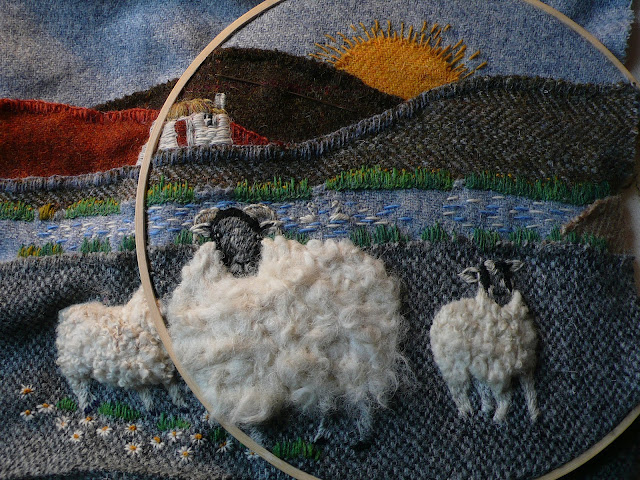
I have often heard it said that the winter months are long this far north, but perhaps that applies to those less occupied than myself. During the summer months the garden, digging peat and general maintenance demand more of my attention, and so when winter does creep in I have a full list of projects. After a highly successful exhibition down in London, one of those projects was to stitch a new flock of sheep on tweed. Over the years they have grown in complexity as I love nothing more than to push myself. There are several different techniques in representing a sheep fleece. For lambs the most common method is the laborious but effective stitching of French knots, while adult sheep are either created with raw wool or couched hand spun wool. When last in Western Australia I collected a bag full of Dorper wool from a friend’s paddock. Dorper sheep are a cross between Dorset and Persian. They have the peculiarity of shedding their wool and therefore do not requiring shearing. The wool is a mass of tight curls and comes off with a felted backing, which is ideal for my needs. There are no rules in my stitching of sheep and in the past I successfully used a crocheted white scarf a friend was throwing out. She thought I could unwind the wool, but I preferred to stitch the scrunched up crochet directly onto the tweed.

The tweed backgrounds are assembled into a patchwork landscape. These can be very simply sky and land, or more complex scenes can include a mountainous backdrop or coastal seascape. Once the sheep are stitched into place more embroidered detail will follow, such as croft houses or shielings, or fencing and flowers. Castles and wind turbines have been known to make an appearance but are less common.

During the run up to Christmas 2021 my work went on show for the first time in London. Possible covid restrictions meant an online presence was vital and the Robert Young Gallery in Battersea produced a wonderful catalogue. The opening night was perfect for mew at least in that it was select, warm and cheery in the perfect intimate setting of fine folk art. The on line catalogue had proved its worth as half the items were sold before the show opened.


Now back on the Isle of Lewis I am preparing for this year’s season and pleased to announce there will be no requirement to make an appointment. However for anyone wishing to view my work it is advisable to send me an email a few days before so as to be sure I’ll be in the studio.     


Friday, January 7, 2022

THE OCELOT


At the start of winter I always like to have a project started no matter where I happen to be. Embroidery work always seems to come into this category due to the time it takes, and this time I’d settle on another big cat. Although not that big, the South American Ocelot or Pardalis as it is referred to in my circa 1800 edition of General Zoology by George Shaw is considered to be one of the most beautiful. The ground colour of the male is reddish tawny above to nearly white on the lower parts of the side, breast and limbs. The richer tinged stripes on the upper part of the body are edged with black and these contrasting colours make it an ideal subject for embroidery. Like the other large cats I’ve embroidered I wanted it to be in raised stump work, but this time the inspiration for a seated pose came from Mr Heath’s fine engraving in said volume. The head however showed a rather vicious grimace, but I preferred a more passive mouth closed. Knowing from the start that it would be a jungle setting and packed full of detail meant I would have to create depth by adding raised detail. The South American jungle provides a wealth of fauna to choose from, but a river through the middle ground allowed me to split foreground and increase that depth of vision. 


I started stitching shortly after my return from Brittany and by the 27th of November I had the Ocelot and raised flower detail completed. Then came the exciting part of positioning those onto the background linen canvas. After a brief trip to London at the beginning of December, for the very successful opening of my exhibition at Robert Young’s Gallery in Battersea Bridge Road, the stitching continued. The week leading up to Christmas saw a significant progress as I concentrated on stitching and not the upcoming mid-winter celebrations. On Christmas day I took some cold left over food and headed out to the coast for a very enjoyable long damp walk. There had been a brief moment of panic before Christmas, when I couldn't find the tail of the Ocelot. During clearing the table I chucked all the scraps into the bin, and along with them was the tail. I noticed my brother had already emptied the bin ready for collection that morning. I frantically untied the plastic bag and to my delight found said tail without too much trouble. A lesson learnt, to be careful when tiding up, something I normally don't do that often.


 By the New Year I was entering the final stages with the foreground detail. At this stage a friend reminded me that the reverse side of embroidery can also be fascinating. So, as I approach the point of completion, I offer you a few images of my winter project.  


Sunday, December 5, 2021

ILL EQUIPPED. (pictures not required)


It had come highly recommended by Polly. “There’s a Constable exhibition at the Royal Academy you must see”. Entitled “Late Constable” it covered a time line from 1825 to his death in 1837. It was a short stroll to the nearest tube station and ten stops on another short walk along Piccadilly from Green Park Station, and a perfect distraction from thoughts of my own exhibition starting that evening.

The pavements were bustling with eager shoppers and the well-dressed seem to carry an air of entitlement and ownership, while the homeless sat cross legged on cardboard, backed up to what would now seem useless telephone boxes, muffled and blanketed against the first real nip of winter. As I approached Dover Street a black woman stood doubled over in obvious distress, tears streaming down her face as she pleaded blindly for help to the passing pedestrians. I drew closer watching people skirting around her, turning their gaze elsewhere and walking on. After all that people have been through over the past two years there must now be a greater awareness of people less fortunate, and surely someone would take notice of such distress.

In the Outer Hebrides I expect to say hello to everyone I come across during my walk, but obviously on the streets of London that is impossible. There is a level of self-imposed isolation that comes with the use of smartphones, a reduction in observation and a cutting off from reality. Headphones in place, they walk and talk, but exist elsewhere. I looked ahead and passed, disgusted with myself for joining the throng.

I paid my £17 entry and spent the following hour transported to another world, enthralled by the magic of Constable. Being able to get so close and study the confident confusion of paint application, no longer aware of my mask. To see his full size preparatory sketches alongside the finished studio work was a delight, flitting to and fro, seeing decisions taken almost two centuries ago.

Pleasantly exhausted I left by the Burlington back doors, my back beginning to feel the strain of concentration. Unmasked I walked on down Old Bond Street and slowed as a woman standing in front of a handbag shop posed, while her husband took a photo. A purchase had been made and she proudly clutched the smart paper carrier bag sporting the shop’s name. I stopped and stared, the tears welling up, a brutal transportation to the reality of today, the contrast too great. I could not survive long on these streets.