Thursday, August 23, 2018
Hebridean Dreaming: STUDIO PAINTING
Hebridean Dreaming: STUDIO PAINTING: During the past fortnight I’ve returned more towards the paintbrush than needle. The major project to embroider flora and fauna on the N...

STUDIO PAINTING

During the past fortnight I’ve returned more towards the
paintbrush than needle. The major project to embroider flora and fauna on the
New Tolsta map quilt has seemed such an open ended task that some light relief
of painting where I can complete a picture in a matter of days was a welcome
bonus. Even when I’m not painting the process still goes on in my head as I
imagine various subjects and compositions. There are some that are as well to
rest in my head and never to emerge but there are others that I am itching to
get onto canvas, and when they do eventually come into the light of day there
is a great sense of joy with just how quick that image arrives. Painting should
never be difficult or laboured as it will always show in the unsatisfactory end
result. If during the painting process I find myself struggling with the image
then I take a tea-break or a walk and usually on returning the problem is
resolved. However there are times when the problem remains and the picture must
be abandoned. This is rare and usually only happens after a sustained period of
studio painting when all I need to do is get back out there and reconnect with the
subject matter; a walk down to the beach or a trudge out onto the moor whatever
the weather. It is hardly surprising that the subject of Garry beach figure
often in my pictures as I not only walk there but work there when cutting peat.
Familiarity with this delightful east facing beach and the history of past
human habitation and activities are intriguing but the play of light during
changing weather conditions make it endlessly fascinating. Being a popular
place for camper van tourists and dog walking locals it is important for me
that I don’t simply reproduce the classic snap shot image that everyone will
recognise. I have sketchpads full of drawing of Garry to accompany a large
folder of photographs and I often find myself working from several different
images. My latest studio painting was executed using three sketches and two
photographs with an element of artistic licence to create the required
composition.

The painting of the castle stack taken from the far cliffs
demanded a similar mix of sketches and photos and the more restricted square
format meant that the subject matter remains very much about the elevated
perspective of the stack and its relationship to the silhouette of Seabhal
beyond.

The slightly smaller square painting looking up to Seabhal from the
beach is more about the patterns formed by the burn running across the sand
from the loch.
Another favourite with all visitors is the “bridge to
nowhere” although being an entire bridge it does in fact go somewhere as it
spans the deep granite gorge.

To obtain the impressive dominance that Lord
Leverhume intended when choosing this site for the cast concrete bridge one
needs to view it from down in the gorge at river level which means a scramble
and then locating a comfortable rock to perch and sketch from. This is not a
suitable place from which to set up an easel so the subject seen from this
angle requires it to be a studio painting.
Sunday, August 19, 2018
COMPLETING THE PICTURE AND THE GENTLE ART OF FAKING..

Back in the summer of 1987 my father bought an oil painting
by the Cornish artist Billie Waters and it was quite obvious even without
reading the auctioneer’s description that it depicted Hayle harbour. Although
somewhat stylised it showed clearly the old factory buildings and storehouses plus
the distinctive row of houses that still stand above the inner harbour. The
style is typical of between the world wars and I could immediately see how the
deceptively simple almost child-like image had caught my father’s eye. The
subtle soft pallet of colours indicated the brushwork of a female hand and it
soon found a home on the upstairs landing. On the reverse of the canvas was
another abandoned oil sketch of a harbour and what I took to be a view of Hayle
harbour from a different view point. The rather heavy half round moulded frame
did not please my father and it was changed for something lighter, while making
sure that the original was stored safely away.

Thirty years on and the painting hung in my brother house
having been reunited with its original frame and I was once again intrigued by
the abandoned sketch. As I was going to St Ives the following day I took a
photograph and when stopping off in Hayle to buy a vegetarian pasty would take
a wander around the harbour area. With pasty in hand I walked in and around the
harbour taking in all the most likely spots but nothing fell into place and it
became obvious that the sketch was not of Hayle. Cornwall is well off for
harbours and I began to think it was an impossible task to now make any sense
of the sketch, so I logged the image away in my head and thought no more about
it.


Billie Waters had abandoned that sketch probably eighty
years ago and it was now my task to complete the picture. After three days I
felt I had arrived at a passable effort that would sit comfortably alongside
the original making a pair to Hayle harbour.
 The story however is not entirely
over because while the oil sketch of Porth Leaven was clear enough there also
remains another partial sketch beneath this. The most obvious part of the
second sketch is a large blue oval body of what looks like water to the left
with three black splodges. There are other indications of brushwork that have
been whited over and bare no relation to the harbour sketch but I can as yet
make little sense of these other than it could be an attempt from closer quarters to capture the flow of water out of through the inner habour wall. Could this yet turn out to be three for the price
of one?
The story however is not entirely
over because while the oil sketch of Porth Leaven was clear enough there also
remains another partial sketch beneath this. The most obvious part of the
second sketch is a large blue oval body of what looks like water to the left
with three black splodges. There are other indications of brushwork that have
been whited over and bare no relation to the harbour sketch but I can as yet
make little sense of these other than it could be an attempt from closer quarters to capture the flow of water out of through the inner habour wall. Could this yet turn out to be three for the price
of one?

Sunday, August 5, 2018
Cooking on a quiet Sunday.

I try to make it a rule to always cook something when the
Rayburn is lit. Even on a cold wet miserable day when it would seem enough
effort simply to allow it to heat the water and radiators I like to get
something in the oven. On inspecting the larder there was ample cake on the
shelf, the biscuit tin was full and below the jam and preserves looked healthy.

Then as I admired the wonderful sponge mincer that I’d picked up for a pound
years ago an idea sprang to mind. I’d make kale and potato cakes as I had both
in the garden and maybe I could try mincing the blanched curly kale and brown
bread. It worked a dream and I have enough for the rest of the week.

Don't you just hate people who take photos of food! Traditionally they are served with cold gammon, or with bacon or grilled sausages
but unless some road-kill turns up I’ll be sticking to the staple vegetarian
mushroom and cheese omelette. I had the remaining mushroom soup at lunchtime,
made with field mushrooms that I’d filled my bonnet with when down sketching on
Garry beach. I can guarantee here in New Tolsta that any fresh mushrooms are
mine by rights or more accurately because I’m the only one who would dare eat
anything that didn’t come in a plastic supermarket wrapper. “I’ve only poisoned
myself once” I say with gay abandon and see them determined to politely decline
any invite to dine at Tom’s house. This year with the dry summer I gave up
bothering with growing lettuce as I now prefer the lemon tang of wild sorrel
that grows here in abundance. I’m also celebrating not buying any jam having
been self-sufficient on that front for the past thirty years.
Having finished cooking I put the scrubbed deer’s head on
the Rayburn to dry. A neighbour had found it on the moor and brought it round
for me in the week. Wonderful that the sight of a dead skull should immediately
make people think of me.
Sunday, July 22, 2018
ALL IS SAFELY GATHERED IN>

It’s been a record breaking year on so many front and many
experienced peat cutters say they’ve never known a year so dry. Back at the
beginning of May while others were sweating it out jogging along the track from
the bridge to nowhere I was hard at work at my peat banks. De-turfing is
perhaps the most detested job as there is nothing to show for the effort but
once the top layer of peat is revealed I get a genuine sense of excitement for
the work that is to follow. The first cut with the tairsgeir (peat iron) and
the season starts. Count up to 30 as I cut, then I stop and throw that batch.
The process is repeated ten times and then I’m done for the day. Anymore and I
risk getting into serious trouble with my back. Throwing is a real art and when
done correctly with skill so that each peat fly throw the air several meters to
land perfectly alongside its neighbour takes years of practice that I don’t
have. Most of the time I have to double handle in order to get the first cut
thrown well out and afford room for the next two or sometimes three layers. After
two hours I’ve had enough and return to continue another less strenuous form of
creative work in the calm of my studio.
After two weeks of lying flat the cut peat should be ready
to lift and set up on edge. There many methods to achieve this but I prefer the
herringbone form with a roof capping which allows the maximum expose surface to
both sun and wind as the drying continues. This year I was lifting after just a
few days and within six weeks most were ready to bring home. So it was time to
call on Murry with his tractor already fitted with the double wheels and a
large peat stack piled high outside the back of his house. All fit for Monday
evening so get a team together. George, Donald, Norman, Mats and myself should
be fine. Murry was already parked up at the banks and loading as we arrived and
everyone stepped easily into the rhythm of work.

There is something very
special about working as a team that I think everyone can recognise and so the
conversation and banter flow easily. With the first tailor full Murry heads
back up across rough ground that’s a fine test of our skill in building a load.
As we wait there is time to chat, reminisce and catch up on village news and as
the chill of the evening breeze starts to bite the tractor returns and it all
hands for the second load. This time it’s topped off with a few bags of caorans (smaller pieces of the best
black but crumbling peat). Job done and back at the house the fruits of all
that labour lie awaiting to be neatly stacked. I’ve changed the position this
year having chopped up and removed a pile of old timber from the back I now
have room for a slightly more sheltered placement.

I plan to incorporate the
bags of caorans into the centre of the stack so returned to the moor with my
van and the wheelbarrow. Having wheeled up 20 bags there now remains only a
further 16 but they will have to wait as my back has finally stopped me in my
tracks and is demanding rest.
Monday, July 9, 2018
THE STORY BEHIND THE DOOR.
I have with age become a creature of habit at least for the
start of each day. There is something very reassuring and comforting in a
routine whereby I can break my fast without having to put my brain in gear at
this early hour. Like millions of others I fill the kettle and turn it on
without a moment’s thought as to where the power is coming from to make it
boil. Then I step outside to greet the day which in recent weeks has been
glorious and walking across the gravel I pluck a sprig of fresh mint to throw
in the pot of green tea. Back inside I open the corner cupboard door and remove
a late 18th century blue and white transfer printed bowl and from
the hook below a heavy Irish potato print mug. Tea and muesli gets me through
to mid-morning but today my mind went back to that blue painted corner cupboard
door and the story behind it.

This door like most of the objects in my house has history.
It came into my possession some thirty odd years ago when I purchased a small
18th century full standing pine corner cupboard painted in drab brown.
From the start it seemed to me that the door was not original and on carefully
scraping away several layers of paint from the body of the cupboard the
original blue colour was revealed. However the door showed no trace of blue and
proved to be a later addition. The cupboard was sold on with a handsome profit
while the door was consigned to my wood store along with other scraps that I
was sure would one day come in handy.
When in 1912 I moved to Brittany there was some serious
sorting out but somehow the door still with its original glass survived the
skip and moved with me. For several years it remained stacked away with lumps
of heavy Breton chestnut and oak until the day I decided to construct a cold
frame to bring on seedlings; the door would, face down make an ideal lid. Over
the next few years it withstood the elements reasonably well but the paint
became flaked under a baking sun and the damp had penetrated the animal glued
joints and puttied glazing. I decided its days where over and so dismantled it
and retrieved the glass. Once again it was placed back in the wood store but this
time tied up with string in a flat pack condition and there it remained for ten
years.
It has always surprised me that in our square
cornered homes there are so few corners that will take a corner cupboard and
the kitchen here in New Tolsta is no exception with three of the corners being
taken up by doors and the forth has the hot and cold water pipes running down on
the surface of the V lining boards. However there was enough room to build a
cupboard and perhaps the old flat packed door would prove useful. I retrieved
it from the wood store and even managed to find the six original panes of
glass. That summer in Scotland I reassembled it and built it into the kitchen
giving it that coat of blue paint it had always lacked. The most extra ordinary
thing, after a chequered history of almost 200 years is that it still retained
its original lock and key. Eat your heart out IKEA.
Friday, July 6, 2018
Moorland trudging from Tolsta to Muirneag.

During my moorland tramping west of New Tolsta the distant
silhouette of Muirneag has for the most part been simply a directional guide
looming on the horizon. One day I’ll head out there, one day. Well today was
that day as the skies clouded over and a gentle breeze picked up which meant I
would neither get over heated or troubled by horse flies or midges. The first
part of the walk was over familiar ground as shortly after 8.30 I crossed the
road and joined the track leading up to Loch Diridean. At the end my goal sat
far off 248m above sea level and only four little squares away on the Ordnance
Survey map that is 4 kilometre as the crow flies. There are those who would be
thinking quad bike but for me that’s way too noisy and my back wouldn’t stand
the shaking up, so trudging it is, one foot in front of the other. I took a
direct line across the divide of upper and lower Loch na Cloich and noted a
distinct drop in water levels since my last time here.

Even more rocks
protruding from the water and here I stopped for water and a slice of homemade
ginger and walnut flap jack. Like the carrot dangling before the donkey I find
promising myself something to eat when I reach certain points does help and the
next would be on reaching the summit. The middle section of the walk across A’
Chleith Mhor is about 2 kilometres and as I tend to look down as Muirneag seems
still depressingly far off.
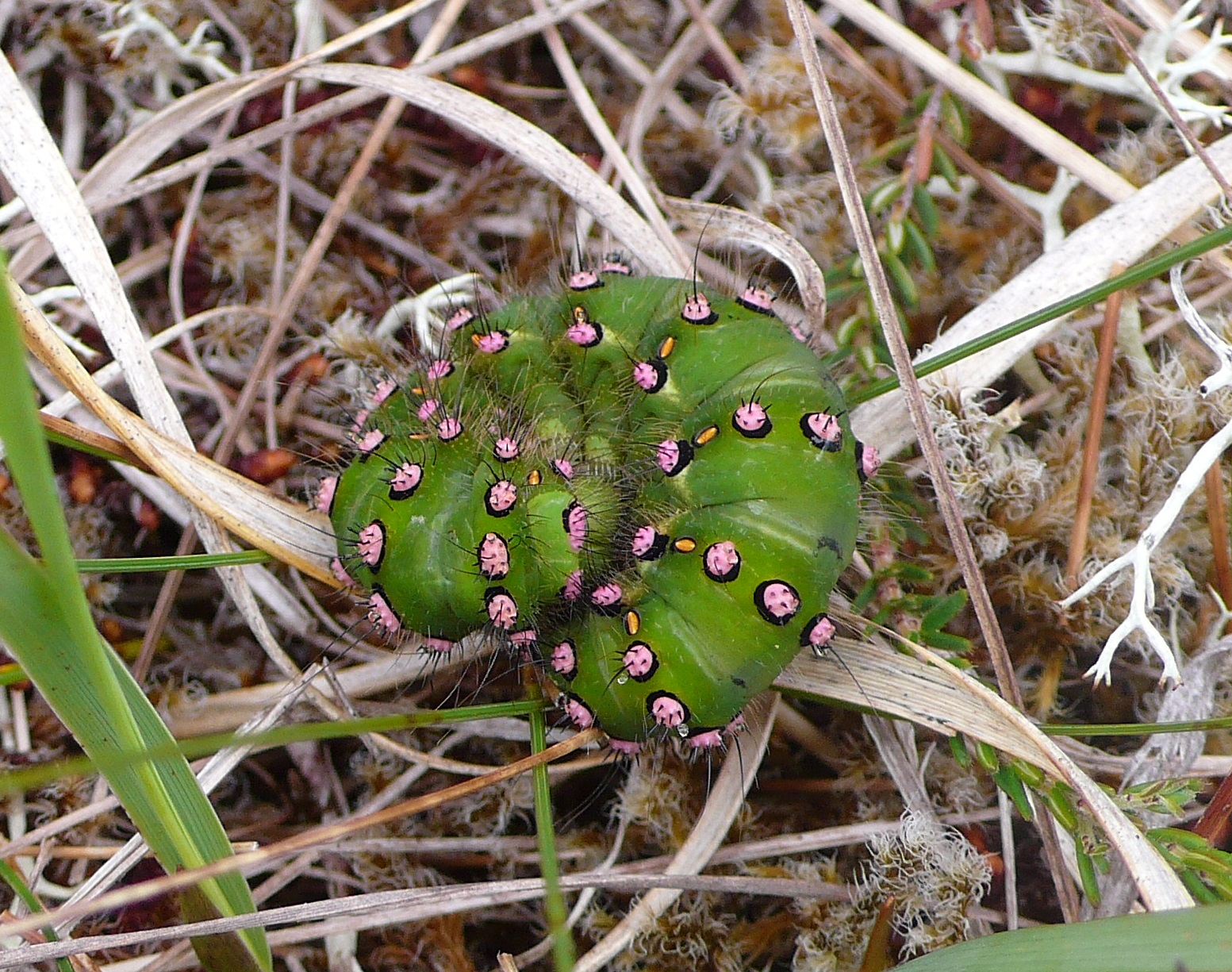
And there I almost trod on it is the large vivid
green caterpillar of The Emperor moth way out in the middle of the moor. I
would have expected it more likely to be on willow or birch but my book tells
me it does live on heather and at low levels it shows less tendency to melanise
so less black than green. Later it will spin a pear shaped brown silk cocoon in
which the large violet-brown pupa will lay dormant for two or more winters
before the moth finally emerges.


Subscribe to:
Posts (Atom)